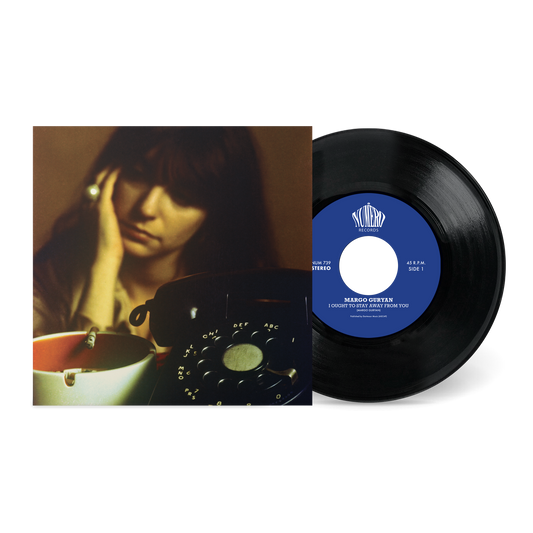
The More I Dream, The More I Know
Margo Guryan’s name is today synonymous with sophisticated songcraft and inimitable 1960s cool. But before the excavation of her 1968 baroque-pop masterpiece Take a Picture—before the discovery of her fantastic 1970s demos, which sat unearthed for a quarter century—her singular path set off from auspicious coordinates in the history of American music.

In August of 1959, Margo was in a practice room at the three-week program known as the Lenox School of Jazz in Western Massachusetts, working in an ensemble alongside fellow students Ornette Coleman and Don Cherry. Her peers were, at that very moment, exploding the consciousness of jazz; the Coleman quartet was months out from the release of its seismic Atlantic Records debut, The Shape of Jazz to Come, and its not uncontroversial debut at Manhattan’s Five Spot. Margo, a then-recent graduate in composition from Boston University, had once been told that the highest mode of education is perception. So she mostly lingered and listened.
The teacher assigned to the Coleman-Cherry-Guryan group at Lenox soon grew frustrated by Margo’s lack of participation. For the previous two weeks of the school, the teacher had not acknowledged Margo; in fact, he had hardly masked his disappointment that he was responsible for advising one of the two female students enrolled at Lenox. When Margo noticed the teacher approaching her that afternoon, she figured he was probably going to ask for a cigarette. Before he could utter a word, she held out a pack of smokes. That gesture won him over. The teacher was Max Roach.

“What are you doing here anyway?” the percussion giant asked, to which Margo replied, “I’m a composer.” Roach walked away, approaching the school’s executive director, John Lewis, leader of the Modern Jazz Quartet, the famed group that emerged elegantly from Dizzy Gillepsie’s big- band rhythm section. Margo watched the men whisper and then insist: “Write something for tomorrow.”
Margo and Roach went on to become friends. In 1961, Roach even asked Margo to pen the liner notes for his first Impulse! album, the radical hard bop classic Percussion Bitter Sweet. But in this moment, her instructor’s task was imposing. Margo stayed up all night and rose to the occasion. A recording of her lyrical composition “Inn Tune,” as performed by Coleman, Cherry, and others at that summer’s student concert, endures today. (Alas, it is one of many early Margo pieces with no existing recording by the composer herself.)
The Lenox School of Jazz “had a profound effect on the history of American jazz and the formation of the American soul,” wrote jazz scholar Jeremy Yudkin in 2006. Margo was one of six women, out of 150 students across four years, ever admitted to participate. What she absorbed from that mountain of improvised music among the Berkshires, she carried forever.
Most listeners familiar with Margo Guryan know her as the chanteuse behind the buoyant and brooding songs of Take a Picture, which became a lost-in-time classic passed around on cassettes among believers until it was properly discovered three decades after its barely-noticed release on Bell Records. Just how deeply rooted her skills were in her adoration for her bebop, hard bop, and cool jazz heroes is a lesser known story. Margo’s secret history in jazz is what she brought to pop, which she had rejected wholesale until hearing Brian Wilson’s Beach Boys masterpiece “God Only Knows” one fateful afternoon.
Margo had little ambition to become a recording artist herself; her dream was to write for others, and in her lifetime she achieved acclaim and success as a songwriter. She was called upon to pen lyrics for a haunting new take of Ornette Coleman’s “Lonely Woman”—transforming Coleman’s free- jazz ode to one woman’s solitude and disillusionment—and the Coleman-Guryan version was covered by the jazz iconoclast Chris Connor, soul great Freda Payne, the spectral duo of vocalist Jeanne Lee and pianist Ran Blake, and a dozen others. (Margo, to the best of anyone’s knowledge, never recorded it herself.) Her early tunes were recorded by bebop pioneer Dizzy Gillespie, bossa nova icon Astrud Gilberto, the famed South African singer and activist Miriam Makeba, and folk hero Harry Belafonte. Jazz singers Anita O’Day and Carmen McRae all released takes on her material, as did pop singer Claudine Longet and folk-rock icon Mama Cass Elliot. “Sunday Morning,” Margo’s biggest hit, was first popularized by soft-rockers Spanky and Our Gang, followed by recordings from torch singer Julie London and country royalty Glen Campbell and Bobbie Gentry. By 1967, Billboard had called Margo “one of the most sought-after writing talents in the music business.”

That Margo was largely unknown for decades was not the stuff of crushed dreams. It was a result of her own choices, based on her priorities and her strong disinterest in performing. The story of Margo Guryan is one of a woman who dug deep from an early age and was never afraid to change. She was privy to revolutions in jazz and pop and she ventured to bridge her knowledge of them—her keen feel for tone, phrasings, tension, presence, and lyrics that cut—in daydreams evoking rain or blue skies or piercing sun. Her ingenuity and technique set her in the tradition of chamber-pop icons such as Brian Wilson and Burt Bacharach; the bittersweet candor in her depictions of womanhood sometimes suggests a middleground between Carole King’s pop-factory and singer-songwriter eras. But the understated rigor of Margo’s artistic voice is all her own. Her songbook took shape at the intersection of mythical moments in American music, and her sound is now a key, opening them.
Queens

Margo Guryan was born in 1937 and raised in a sprawling family home at 856 Central Avenue in suburban Far Rockaway, Queens. Margo’s grandfather, a Russian-Jewish immigrant and radiologist, built the house, filling its nearly 20 rooms with oil paintings, Japanese tapestries, and a grand piano flanked on either side by marble sculptures. The family had a Siamese cat. The backyard opened onto barren woods. A statue of the Buddha capped the banister of an ornate staircase leading up to the third floor, where Margo and her parents lived.
Her grandfather died when she was only a year old, after which her grandmother Bertha presided over a household that included (during the Great Depression) her three daughters, two of their husbands, and two grandchildren: Margo and her cousin Peter, who was the same age as Margo and became like a beloved brother. “It was a crowded place,” Peter Shulman said in a 2023 phone interview. “Because of the distance between floors and rooms, my grand-mother had a system where she would whistle certain tunes—a different tune for each daughter and grandchild. If she wanted you, she’d whistle and you knew you better go upstairs to see your grandmother.”
Margo’s parents met at Cornell University in the early 1930s. Her mother, Evelyn, studied piano, though Margo never heard her play; she ultimately became an x-ray technician and, later, head of radiology at a Long Island hospital and the founder of a radiology school. Margo’s father, Seymour, also a Russian immigrant, did not work. He stayed home, where he often played piano—“mostly by ear, kind of a 1920s style,” Margo said in a 1959 interview—which he taught to his daughter beginning when she was six years old. He favored Tin Pan Alley standards, playing her “Tea for Two.” “He surely loved music and was an enormous influence on me,” Margo once said. It was Seymour who bought her a record player and her first albums, including LPs by British pianist George Shearing (East of the Sun) and “the first lady of jazz piano,” Barbara Caroll.
Peter—who became a painter, firefighter, diving instructor, and farmer, among other professions, and who would oversee an upstate land-art installation entitled “Peter Shulman’s War”— described Margo’s father: “A brilliant man, but not work-oriented. He didn’t do too much, but he was a great musician. He sat at the grand piano in the living room every day and played constantly. Margo and I grew up listening to piano music through the whole house.” Margo’s parents had many musician friends, who would come over to play on weekends: “It was like a concert every Saturday night,” Peter recalled.
 With her father’s early instruction, Margo became a precocious talent, practicing every day. But she did not begin as a willing participant in her lessons. “I was against it....My parents forced me into studying,” she said in 1959. “They said I could quit when I was 13, if I wanted to, but every time I was going to quit, I had a funny feeling that maybe they were right.”
The household was a matriarchy of sorts. Margo’s mom was the breadwinner; Margo’s aunt Eleanore had studied at the Sorbonne in Paris. In an era where the unspoken, widespread dissatisfaction within women was emerging as “the problem that has no name,” fueling second-wave feminism—when many women did not have the tools to clear the hurdles of their own imaginations—this was an unconventional household, where Margo was prescribed no limit on what she could do or be. “My family was women-oriented,” Peter said. “My grandmother ruled the roost after my grandfather died. My father never said no to my mother about anything. The women were the bosses.”
Margo was well-loved by her parents, who encouraged her musical pursuits. But at home she was also witness to abuse enacted against her cousin by her uncle, who would whip Peter with a belt when he misbehaved. According to Peter’s wife Gaye, these experiences instilled both anger and empathy in Margo at a young age. Decades later, Margo and Peter learned that he had been adopted on the black market with a forged birth certificate.
Boston
In 1955, Margo enrolled at Boston University, where she initially studied classical piano but ultimately switched her program to composition—to get out of performing her senior recital. She had been introduced to jazz by her father, but Margo truly fell in love with the music at college, listening to guys in B.U.’s practice rooms. She became so smitten with improvisation that she missed Elvis and The Beatles entirely. Throughout her life, she consistently cited Bach as her favorite composer, but now her admiration was growing for jazz pianists like Ahmad Jamal, Bill Evans, Thelonious Monk, Horace Silver, Kenny Drew, and Hampton Hawes.

Margo enrolled in an elective jazz history course taught by George Wein, who she knew was a prominent booker about town, impresario of the Storyville jazz club and Storyville record label, and the founder of the Newport Jazz Festival. In the late ’50s, Wein took Margo under his wing. When he and his wife would go out of town, Wein gave Margo the keys to his apartment so she could practice on his grand piano.
Though Margo was underage, Wein let her enter Storyville through a side entrance to see music. On one such occasion, she went to see the Miles Davis Quintet; when the intermission pianist for the concert didn’t show up, a club manager, knowing Margo was a music student, asked her to fill in on the spot. “No way,” Margo insisted. Up in Wein’s office, after a few drinks, she obliged. Margo recounted the events to It’s Psychedelic Baby magazine in 2018:
“I just played my own songs (jazz-tinged at the time) one after the other. I wasn’t a performer... didn’t smile or look at the audience... just played until I was tapped on the shoulder. I got up and began walking down an aisle when someone approached me. I couldn’t see very well because the room was dark and my eyes were still adjusting, having had a spotlight on me. This person put his hands on my shoulders and said, ‘Yeah, baby!’ It was Miles!!”
While Margo was still in college, Wein offered her a deal with his Storyville label. But Margo’s father thought they should show the contract to a lawyer, who felt she could get a better deal in New York. Looking around at other labels, Margo was ultimately sent to Atlantic Records, where she auditioned for the label’s legendary chiefs, Ahmet Ertegun and Jerry Wexler, men synonymous with the very essence of American music. Atlantic was founded on R&B, jazz, and jazz-leaning pop, but when Ertegun’s brother Nesuhi joined the label in 1956, he began to attract top jazz names, like John Coltrane, Charles Mingus, Ornette Coleman, and the Modern Jazz Quartet. “My parents insisted on accompanying me to the Atlantic meeting...which was embarrassing,” Margo said. In Ahmet and Wexler’s office, “One of them said, ‘OK, let’s have your demos,’” to which Margo asked, “What are demos?” They rolled their eyes. “What did you expect to do for us?” one of the men replied. She thought she would be auditioning her songs.
Ahmet and Wexler took Margo to another office with a piano. She played her songs, one after another, and five or so in, “One of them reached into a desk and pulled out a bunch of song contracts. They asked me to go around the corner and do exactly what I had done for Tommy Dowd, who was their engineer at that time...and that’s how I found out what ‘demos’ were!”
Signing Margo not only as a songwriter but as an artist, Atlantic arranged a recording session in which she would sing her own songs, with Nesuhi handling production as he had for Coltrane, Mingus, et al. Margo later called the proceedings “a total disaster” on account of her racked nerves. She never considered herself much of a singer, and though her hushed vocal phrasings would prove prescient in the decades that followed Take a Picture, they didn’t fit in with the conventions of late ’50s jazz.
Decades later, Margo was remarkably realistic about her own limitations and what went wrong that day. “I have a range break, right around G above middle C,” she told Chicago Reader in 2002. “Above that I can sing, but it’s almost falsetto. Below it I can sing in full voice. It was an inconsistent sound. And the more they told me to sing out, the worse it got.”
After wrapping the aborted session, Nesuhi drove Margo back home to Far Rockaway. They eventually became good friends, continuing to correspond after Margo went back to school in Boston. One tune from that day, “Moon Ride”—an inquisitive chronicle of a trippy voyage to outer space—stuck out to Atlantic, and the label brought it to cool jazz singer Chris Connor, who turned it into a sultry, spellbound 1958 single. When Connor recorded what would become Margo’s first commercial release, it was Nesuhi who delivered her the news.
“How did you ever think of those weird lyrics?”
During her last semester of college, in 1959, Margo entered a competition to win a scholar-ship to the recently-founded Lenox School of Jazz. As part of the contest submission, her Margo Guryan Trio appeared on Boston University’s emerging student radio station, WTBU, performing and giving a rare interview with DJ Stephanie Saltman. (The voices of women DJs were still uncommon on the radio then.) Featuring bassist Larry Richardson and drummer Al Francis, a tape of the segment was sent off for the intercollegiate competition. As the radio host explained, most of the competing students from 13 schools were Ivy Leaguers, and Margo was the sole woman among the 21 finalists.

Margo had by then been playing jazz for about three years. On the radio, she described taking piano lessons with Jaki Byard (then on the brink of joining Mingus’s band) and traced her journey from “good ol’ Far Rockaway High School” to B.U., where she thought majoring in piano would just be easy. “I didn’t want to study math or science or anything,” Margo added. “It turned out to be a lot of math involved with composition, much to my surprise.” She discussed the ratio systems behind the theory of “dynamic symmetry,” its origins in Greek architecture and its applications to the harmonies and counterpoint of Beethoven and Bach. “It’s supposed to be found in all things that are perfect,” she said, a possible gesture towards the perfection she was always striving for in her idiosyncratic pop. Another topic of discussion was Margo’s recent release “Moon Ride.” “How did you ever think of those weird lyrics?” the host asked. Margo said she was trying to write a rock tune for one of her young cousins, who had often goofed on her taste in music.
With a bit of uncertainty, Margo described her plans for the future: “Possibly some more studying in New York with composition and piano. Try to see if I can get a job playing some place. Get some songs recorded.” For the moment, she was focused on Lenox—a convergence, she said, of “the finest composers” across three weeks of intensified inquiry into the past, present, and future of jazz. “I would very much want to study with John Lewis or Gunther Schuller,” Margo said, referencing the Modern Jazz Quartet pianist and the composer known for classical-jazz hybrids that he called “Third Stream” music. Both men had collaborated with Miles Davis in the landmark sessions, in 1949 and 1950, that became Birth of the Cool, and both would eventually shape Margo’s career considerably.
“It’s a dream for all of us,” Margo added.
Lenox
12 13 The Lenox School of Jazz was founded in 1957 as an outgrowth of the Music Inn, a venue in the Berkshires established by New York transplants and hoteliers Stephanie and Philip Barber. Located down the road from the classical music institution Tanglewood, the grounds of Music Inn included a mansion, converted stables, and a barn that hosted concerts. It was framed as a resort where vacationers could not only see icons of jazz, folk, and gospel like Billie Holiday, Louis Armstrong, Pete Seeger, and Mahalia Jackson, but also sit for music lectures and jam informally around the properties with other guests. Music Inn was widely received as a boon for jazz, with New York Times critic John Wilson writing in 1956: “It’s a long trip from dingy backroom dives in New Orleans to a sun-bathed, verdant hillside in the Berkshire Mountains of Massachusetts, but jazz has made the journey.”

It was a long trip for a girl from Queens, too, but Margo found her way. Although the Lenox School operated at a financial loss for the entirety of its four-year existence, it was glowingly highlighted in the press as “groundbreaking,” “a pivotal point in the history of jazz,” and “the most important step taken” yet for the music. It effectively invented jazz education in America. The school’s distinguished faculty included Dizzy Gillespie (who called the atmosphere “creative and therapeutic”), Max Roach, Bill Evans, J. J. Johnson, Kenny Dorham, jazz historian Marshall Stearns, and others. The Modern Jazz Quartet was the ensemble-in-residence. Gunther Schuller, who had also played French horn in the Metropolitan Opera Orchestra, was on the Governing Committee and taught jazz history and composition. Schuller would become Margo’s most important mentor at Lenox; he went on to win the Pulitzer Prize for Music in 2014.
“It was a wonder to find yourself in the middle of these people and this music,” Margo reflected in 2003. An extraordinary number of her fellow students went on to important music careers, including pianists Ran Blake and Steve Kuhn, composer and arranger Michael Gibbs (the orchestrator of Joni Mitchell’s epic “Paprika Plains”), saxophonist J. R. Monterose, pop psychedelicist (and infamous conspiracy theorist) Tupper Saussy, and many others.
Concerts, lectures, and instruction formed the basis for Lenox’s pedagogy, but just as important was how the school employed jazz musicians as teachers and fostered discourse and community. A Life magazine spread compared Lenox to Vermont’s Bread Loaf Writers’ Conference and Michigan’s Interlochen Center for the Arts. “There was a real atmosphere of scholarship and dignity,” Sonny Rollins said in Yudkin’s book The Lenox School of Jazz. “There’s no place quite like it now.”
Around 50 students attended each summer; in 1959, Margo was one of two women students, and “patronizing attitudes [toward them] were common,” according to Yudkin. Typifying this attitude, the January 9, 1958, issue of Downbeat magazine asked on its cover, “Can Women Play Jazz?” to preview a story headlined, “Women in Jazz: Do They Belong?” (Despite the egregious misogyny of these headlines, the article was really a two-page defense of Mary Lou Williams.) “Maybe the problem must be solved outside the precincts of jazz,” the magazine wrote. “Maybe it’s the psychological and sociological areas [where] it must be faced, analyzed, and brought to some reasonable conclusion. Certainly the tensions that develop when men and women play together are not entirely of a musical nature.”

Margo’s experience was still overwhelmingly positive. “She loved Lenox, she was crazy about it,” recalled jazz singer Nancy Harrow, a good friend of Margo’s who recorded a number of Guryan songs for her 1963 Atlantic album You Never Know. After Lenox, Harrow said, “Margo knew the whole jazz world.”
Many of Margo’s earliest songs remain timeless because of the insight, wisdom, and biting honesty with which their lyrics narrate young womanhood, describing the in-betweens of nascent romance—the thrills and turbulence of being “Half-Way in Love,” a song about protecting oneself while in the throes of a crush. “Where’s the laughter of the night before?” she asks, knowingly, on “The Morning After.” On “Kiss & Tell,” she makes the title an imperative, insisting that a new suitor tell his old girlfriend about their new dalliance (like a piano-jazz “Call Your Girlfriend”).
Being one of so few women at Lenox, she naturally drew attention. “She was the object of a few peoples’ desire in that day,” said George Schuller, son of Gunther and an archivist of the school’s history. “Everybody loved to be around Margo. In those days, women associated with jazz were targets, in a sense. She was strong enough to ward off some of the suspect cats. Everybody wanted to date her.”
Among Margo’s boyfriends was pianist Dick Katz. Nancy Harrow recalled how Margo eventually broke it off with him: “He didn’t accept her as a musician, and she was insulted. I remember her telling me how irritated she was that Dick wouldn’t introduce her as a musician. He would be talking business, and would act like she was just his girlfriend, and wouldn’t say that she was a musician.” Men tended to underestimate the talents of their female peers, writing many off as “the girl singer, and that was it,” as Harrow put it. Margo took herself seriously; she ended the relationship.
Max & MJQ
Post-college, Margo was working as a secretary for legendary jazz producer Creed Taylor in 1960, the year he founded the soon-to-be iconic Impulse! records. (Margo took three weeks off from work to go back to Lenox that summer.) She picked up the office phone one day in 1961 to find that the caller—from Impulse!’s parent company, ABC-Paramount—was trying to reach her: Would she like to do some liner notes? “I said, I’d love to, but how would you know that?” Margo recalled. “I had never done it before.” Max Roach had requested her.
At ABC-Paramount, she interviewed her former teacher about Percussion Bitter Sweet’s unusual time signatures: “The artist should reflect the tempo of his time,” Roach told Margo. Her notes commented on Roach’s “enormous sensitivity” and “harmonic freedom,” which, she wrote, was “by no means coincidental to the central theme of the album." Percussion Bitter Sweet touched on a spectrum of freedom struggles, from U.S. freedom riders and sit-in demonstrators to the fight for South African independence.
Margo’s apprenticeship was ongoing. “The music you are about to hear may shock you with its naked transmittal of outrage, desire, hopefulness, arrogance, demanding and tenderness,” she wrote of Roach’s record. “The voicing of the chords, the contours of the melodies, the drive and opposition of rhythms are astonishingly successful in conveying to all who listen the picture that is being painted.” She took notes.

After Lenox, Margo signed to John Lewis and Gunther Schuller’s pioneering jazz publishing company, MJQ Music, as a lyricist. Atlantic and MJQ didn’t have a formal partnership, but Nesuhi and Lewis were good friends; the label encouraged its jazz artists to sign on with MJQ as they inked Atlantic deals. “Signing with MJQ was a huge deal for Margo,” George Schuller said. “Publishing jazz artists, at that time, was kind of a rarity, and especially musician-run publishing companies. MJQ became the publishing company that everybody wanted to be associated with. They were fair. Even Ornette Coleman signed up with MJQ Music. It was, I would say, prestigious.
Most of Margo’s writing with MJQ was done on assignment; she’d be given a piece of music and Lenox School of Jazz, 1959 asked to write accompanying lyrics. Her most impressive feat during this period was writing the brooding, desolate words for a new version of Ornette Coleman’s “Lonely Woman,” the opening track on The Shape of Jazz to Come:
Lonely in the night she wanders
Who can she tell of her heartache
They that listen do not care [...]
She is a lonely woman
No one to cry to at all
Once she wore a smile of gladness
Now on that smile there are teardrops [...]
Once she loved a man
Don’t bother to imagine how she loved him
You’d never guess at all
She never told the secret of her sorrow
Margo also brought a song to MJQ called “On My Way to Saturday,” which she’d written as a teenager on the piano in Far Rockaway, “daydreaming about Harry Belafonte singing it.” Belafonte eventually recorded it for 1962’s The Many Moods of Belafonte. Margo immediately got a check from Belafonte’s label RCA for $1,500, the most money she’d ever made, which she spent on a red winter coat: “I would tell people the coat was a gift from Harry Belafonte!” (She once ran into him on the street in New York and got to personally thank him for it.) Other Guryan lyrics were set to music by the likes of John Lewis, vibraphonist Gary MacFarland, and valve trombonist Bob Brookmeyer, who was a teacher at Lenox, and whom Margo married in the fall of 1964.
The couple lived together in Greenwich Village, where Brookmeyer gigged regularly as a member of the Gerry Mulligan Quartet and the Clark Terry-Bob Brookmeyer Quintet. Unlike his wife, Brookmeyer was a jazz traditionalist. While Margo had collaborated with Ornette, Brookmeyer was among the Lenox staff who were irate at the school for inviting the boundary-obliterating saxophonist; he in fact quit the faculty in protest. In her marriage to a jazz musician of such rigid orthodoxy, “listening to pop music was verboten,” as Margo put it.
But they had obvious rapport. The year of their marriage, Brookmeyer released the Bob Brookmeyer and Friends album on Columbia; during the sessions, he tracked an instrumental tune composed by Margo called “Time for Two,” performed by the formidable lineup of Brookmeyer, Herbie Hancock (piano), Ron Carter (bass), Elvin Jones (drums), Stan Getz (tenor saxophone), and Gary Burton (vibraphone). (It was included on reissues.) Margo and Bob didn’t have children, although they enthusiastically babysat for musician friends like Gunther Schuller and Nancy Harrow, whose son, Damon Krukowski—later of the dream-pop bands Galaxie 500 and Damon & Naomi—would one day watch his generation of indie musicians embrace his babysitter’s brilliance.
Margo and Brookmeyer’s marriage lasted only two years. “I think he was very hard to live with,” said Margo’s stepson, Jonathan Rosner. “She would talk about him in very high regard as far as his musical abilities were concerned, but I remember as a little kid going to their apartment in the Village and she showed me this patched-up piece of wall that he had punched a hole in. He drank and apparently had a bad temper.”

Margo cited her marriage to Brookmeyer as part of her decision to not perform live or tour after the release of Take a Picture: “I don’t know that it’s really stage fright,” she said in 2018. “I just didn’t want to perform. Having been married to a performer, a jazz musician, I didn’t like what I saw of the business and the control that people had over you—managers, agents told you where to be, when to smile. It just didn’t seem all it was cracked up to be when you were a child and wanted to be a big star.” Having seen the unforgiving slog of touring up close, she had no illusions.
God Only Knows
Margo had been writing primarily for jazz artists, making no money. One fortuitous day, in 1966, jazz pianist and composer Dave Frishberg, a good friend of Margo’s, came over with a record that she had to hear. Frishberg was on his way to becoming a legend in his own right, with songs recorded by the likes of Blossom Dearie (he wrote the lyrics to “I’m Hip” that year) and, eventually, Diana Krall, Anita O’Day, and Tony Bennett—though he’s perhaps most famous for writing the surrealist pro-democracy tune “I’m Just a Bill” for Schoolhouse Rock. But the record Frishberg had to play on this day was outside both of their typical wheelhouses.
When Margo heard “God Only Knows,” the wistful and wonderstruck pop symphony at the center of The Beach Boys’ Pet Sounds, her life changed. She was 28 and awed. Never before had pop music affected her at all. “She really didn’t like pop music until then,” Jonathan Rosner recalled. “Margo thought that music was kind of dumb. When Dave played her this, she just couldn’t believe it.” In his own pursuit of glory within a three-minute pop single, Brian Wilson had found himself obsessed with, and driven by, the ecstasy and ache of The Ronettes’ “Be My Baby.” A lineage of American dreaming emerges: from Ronnie Spector, the teen idol in Spanish Harlem; to Wilson, the melancholy surf-pop mastermind in California; to the Queens daughter of Russian-Jewish immigrants channeling her confidence toward her own introspection and illumination.
Margo soon stopped into a record shop to procure a copy of Pet Sounds for herself. “There was a long line outside the store, which I bypassed,” Margo recalled. “Inside the store, a clerk asked me what I wanted. When I told him, he said, ‘Get in line!’”
“When I got home I put my newly-purchased record on; I listened to all the songs, but returned to ‘God Only Knows,’ which I played over and over again,” Margo said. “Then I turned off the record player, sat down at my Wurlitzer, and wrote ‘Think of Rain.’”

Elaborating on her awakening with “God Only Knows,” Margo wrote in 2008, “I thought the melody was beautiful, loved the contrapuntal vocal parts and, best of all, sorted out how the chords were determined by the bassline. It was somehow like a composition lesson I had missed in class!”
Margo began listening to pop radio and was surprised to discover that she liked more of what she heard. That included The Beatles, The Mamas and the Papas (Cass Elliot would record Margo’s “I Think A Lot About You” in a cabaret style for her final album in 1973) and her eventual friend Harry Nilsson, who recorded a never-released take of “Think of Rain.” “I thought what was happening in pop music was more innovative than what was happening in jazz,” Margo once recalled. “Everyone in the jazz world was trying to emulate Ornette Coleman. And there was only one Ornette!”
The April-Blackwood Years
As she developed a repertoire in her evolving style, Margo was looking for a new home for her poppier songs. Visiting with her former boss, Creed Taylor, Margo played him “Think of Rain,” her delicately devastating Wurlitzer rumination about the matrixes of memory that sustain relationships. Simple only on the surface, the song ought to have become a standard.
Taylor sent Margo to April-Blackwood, the publishing arm of Columbia Records, where she met manager David Rosner—who she would marry in 1970. Rosner had grown up in Queens, too, although on a markedly different musical path: Obsessed with doowop as a leather-jacketed young rock’n’roll fan, Rosner spent his adolescence listening to Alan Freed on a transistor radio under the covers.
Rosner’s adoration of Margo shines through his original Take a Picture liner notes. “You get the feeling she likes what she is both personally and musically, that individuality and uniqueness are the only paths open to her,” he wrote. “Margo’s music expresses the feeling that life is to be lived and love is to be loved.” His son Jonathan (from his previous marriage) believes most of the songs on Take a Picture—“the positive ones”—are about his father.
Initially, as usual, Margo wanted to write for other artists. With this in mind, and a demo for her recently-penned “Sunday Morning” in hand, she had been advised to check out a New York warehouse where the sunshine pop group Spanky & Our Gang was rehearsing. She had been given the address and told to just show up. The band, slightly confused, asked her to play some demos on the spot. In late 1967, they made “Sunday Morning” a hit, reaching No. 30 on the Billboard Hot 100 chart before Margo had recorded her own take. In appreciation for the first group to embrace her new direction, Margo wrote the response tune “Spanky and Our Gang,” which was backed by Margo’s “Sunday Morning” the following year as a promotional single on Mala Records, a Bell Records subsidiary. A promotional film for the single was shot at Palisades Park in New Jersey. Margo starred, striking a maternal figure as she skipped around the carnival rides with a pack of kids.
As David Rosner took her demos around, the question persisted: Why not record Margo? She was self-conscious about her voice, but Rosner pressed on, and when he suggested she double-track the vocals, the process stuck. A deal was hatched with Larry Uttal and Bell Records, which, in 1967, had released LPs by Al Greene, Mitch Ryder & the Detroit Wheels, and The Box Tops, who’d scored a #1 single in August of that year with “The Letter.”
The year 1967 had also seen producer Tommy LiPuma commission Randy Newman and Margo to pen Christmas songs for Claudine Longet, as an A&M Records single: Margo’s “I Don’t Intend to Spend Christmas Without You” backed by Newman’s “Snow.” Under direction to write a Christmas song without reference to sleigh bells and other Christmas clichés, Margo completed hers in a day and mailed it to Longet in France. (Half a century later, Frank Ocean played Margo's demo on his Beats 1 radio show.) Born to a Jewish family, like Newman, Margo identified as an avowed atheist throughout her adult life.
“Cryin’ in the sunshine”
The Take a Picture sessions took place in the early part of 1968 in Studio B of Columbia’s studios at 49 E 52nd Street in Manhattan. To produce the record’s immaculate music and assemble the players, David Rosner originally brought in John Simon, who had recently worked with Leonard Cohen, Simon and Garfunkel, and The Band. But after producing and arranging Margo’s “Don’t Go Away,” Simon suddenly left to work on Cheap Thrills by Janis Joplin’s Big Brother and the Holding Company. Needing a replacement, Rosner called upon another writer at April-Blackwood, 26-year-old John Hill, who had never produced a full album and was a bit flabbergasted by the assignment. “I was basically a rock’n’roller,” Hill said. The Beatles were a crucial influence on his earlier work, particularly the psychedelia and backwards guitars of “Tomorrow Never Knows.” That sensibility cracks through Take a Picture—most prominently on five-and-a-half-minute closer, “Love.”
“Margo wrote the songs; my job was to make them sound as good as possible. That was about it,” Hill said. “But her songs were unusual. The chord changes were quite sophisticated. People didn’t write like that.” It was “the heyday of session musicians,” when records moved fast, and Hill strove to get the best possible players. Hill believes certain of the record’s personnel have typically been miscredited; he remembers drummer Bernard Purdie appearing on at least a few tracks, as well as contributions from guitarist Hugh McCracken. Hill played guitar on “Love,” and remembers David Rosner playing harpsichord on that track.
“Why do we grow/And never show/The little that we know of love?” Margo sings at the end of Take a Picture, a fitting query to conclude an album about how very complicated love can be. The songs of Take a Picture rarely convey a single emotion; beneath the sheen, nearly all of them contain at least a touch of sadness, if not plainly-stated tumult. The “sunny days, happy times” introduced by the title track are quickly belied by the song’s deeper impulse: to snap a photo “just in case of cloudy days to come,” capturing the sanguine reality of overwhelming feelings that might be too good to be true. The shifting, tricky time signatures on “Don’t Go Away” evoke the internal frenzy of suspecting that someone is about to leave you. Heavier than its featherlight build suggests, “Love Songs” plays out like a movie—a stark, breathtaking ballad about hearing “pretty love songs” that sneak up on you, stirring once-lovely memories that have become uneasy, stopping you dead in your tracks:
Today
I was crying in the sunshine
When someone said
‘Is something wrong?’
And I said, ‘No, it’s just a song
And I can’t tell you why
Pretty love songs always make me cry’

The intimacy of Margo’s distilled lyrics is emphasized by the quietude of her singing. At times, her hushed vocals bring to mind the yé-yé pop coming out of France in the ’60s—her bohemian sense of style on the cover emphasized as much—as imagined by a singer with all the sensitivity and finesse of a seasoned jazz artist, and a tricky compositional sense more akin then to, say, early Randy Newman (a comparison that sticks even more with her ’70s material). Really she sounds like no one so much as herself.
In early conversations about Take a Picture, Margo knew what she wanted. “She was very specific,” Hill said. On “Someone I Know,” she interpolated Bach’s “Jesu, Joy of Man’s Desiring” in the background; the song plays out in counterpoint. For the psychedelic “Love,” the lyrics consisted of just five questions; for “Thoughts,” she limited each line to a two-word phrase. The impetus for “Sunday Morning” is more surprising: Margo was in Rosner’s office at April- Blackwood when he was visited by comedian Len Maxwell, and they were all listening to Margo’s new demo for the sensual “Come to Me Slowly.” “Len was kidding around with the lyrics to that song...saying it was a ‘dirty’ song,” Margo said. “I thought I’d write a really dirty song with lyrics that were unmistakable.” (Although there’s no mistaking what Margo meant by “[we can] do what other people do on Sunday morning," Rosner was probably correct in telling her “Sunday Morning” wasn’t really all that explicit.)
Hill recalled Margo being comfortable in the studio. “I wouldn’t describe her as having a lot of confidence, but she had enough,” Hill said. “She was more affable than most, but she had her own point of view. She wasn’t difficult by any means, but she wasn’t a pushover either.” (Part of the reason she amassed such a trove of her own demos through the ’70s was that she felt other artists could rarely get her time signatures right.)

Hill added, “The key ingredients are her jazz sensibility, and her perfectionism...but nothing was ever perfect. That’s life. Margo was very concerned about the way her vocals sounded. There was never a point where she was happy with it.” But she accepted the limitations she heard in her own vocal work. “I think she would have liked to be a different kind of singer, but she wasn’t— and it worked out fine,” Hill said. “It was not only fine, it was perfect.”
After the recording of Take a Picture, Margo didn’t know what to expect. “It was a whole new world when she went to pop,” Nancy Harrow recalled. “I didn’t think of her as a pop music person, though. It just seemed expressive of Margo.”
In an October 1968 capsule review, Billboard called the album “impressive”: “She exudes warmth and sensitivity [...] She has a fine sound and a commercial one for today’s market, which should insure strong sales for the well-done package.” But Margo was clear with Bell that she wouldn’t tour or perform in support of her record. In turn, the label did little to push it beyond pressing a few promotional singles. “She was invisible from that point on,” said Hill, who remained friends with Margo. Within a year, Margo would find Take a Picture in the 39¢ rack at Tower Records in New York.
Shine
After Take a Picture, Margo relocated to L.A. with Rosner, whose music publishing career was in full bloom. Rosner worked with Elton John early on; when the English singer-songwriter arrived in the U.S. for the first time, it was Margo and her husband who greeted him at the airport, and John would remain a friend for life. The family lived comfortably from David’s success. David and Margo occasionally worked as a production duo for others, including psych band Wool and singer-songwriter Van Dunson. In 1970, the couple also produced the debut solo album by their friend David Frishberg (who had turned Margo on to “God Only Knows” a few years earlier). Entitled Oklahoma Toad, it was one of the first releases on Creed Taylor’s CTI label. David Rosner also encouraged Margo to keep writing.
Her ’70s material contains an assured, plainspoken voice, her Queens accent peeking through, her lyrics ever-sharper and more specific. The crescendo that propels the eloquence and vulnerability of the ballad “Shine” glows with the feeling of being remade by love, of inner ascension. “Something’s Wrong With the Morning” is a beacon of self-awareness as the certainty of a relationship frays. “Values” seems to narrate the psyche of a woman learning to think independently for the first time, a possible anthem for women’s liberation. “I Think A Lot About You” and “Most of My Life” describe opposite ends of romance, the onset of infatuation followed by a personal reckoning.

Margo also wrote a fantastic trilogy of concept songs inspired by the Watergate scandal: “The Hum,” “Please Believe Me,” and “Yes I Am.” Like many, Margo despised Richard Nixon and was fixated on the trials. Her stories could be captivatingly oblique, and never didactic. Even a verse on “The Hum” containing the lyrics “The V.P. left with the dough he took/And the P. tells the world he’s not a crook/And the tapes go hmm-mm-mm-mm....” is all the more beguiling for how Margo pairs this shocking historical moment with a cheerful sing-song melody serving, perhaps, as a metaphor for how the controversy became entertainment.
David Rosner had a long working relationship with Neil Diamond, and Margo collaborated with some of Diamond’s band on “California Shake,” mixing a sinister edge with a shuffle. The song presents an apocalyptic unfolding of events at the subduction zone of the San Andreas Fault: “No time for thinking/Your life is at stake/Everyone’s doing the California Shake.” If Margo’s semi-topical pop experiments seem a far cry from the ease of Take a Picture, they are also in keeping with her roots in jazz, which offered a defiant alternative to radio pop of the era, just as the “broadside songs” of ’50s folk music did.
All of Margo’s minimally-produced ’70s gems were completely unavailable until her 2001 compilation 25 Demos, later issued as 27 Demos and 29 Demos. Through her phases of activity, recognition, and lack thereof, Margo always lived a life of music. She became a piano teacher toward the end of the ’70s as she focused on raising her stepson. She filled her house with a big, eclectic record collection, hundreds of volumes of sheet music, and her instruments—the grand piano in the living room, the Wurlitzer in the front hall, and various percussion instruments, ready for friends to play along.
The Soft Pop Queen of Japan
In the late ’90s, Jonathan Rosner was in the office working at his dad’s publishing company, Bicycle Music, when they received thousands of dollars in royalties from Japan for Take a Picture, which seemed odd: her songs had never been released there. “We were scratching our heads,” Rosner recalled. “It had obviously sold some copies, but it wasn’t out.” They discovered the music had been pirated, although in Japan, music law worked differently. As Rosner explained, even a pirate deciding to make an unauthorized pressing of a record had to turn in the song titles at the pressing plant, and the plant paid the rights society. “That’s how we ended up getting paid for it, and it opened up from there,” he added. “We did some digging. She had been written about in a book there. She was almost like the Soft Pop Queen of Japan.”
Until that moment, as far as Margo and her family were concerned, Take a Picture was just a cool piece of history; and though Margo was proud of the record, she had long regarded it as a closed chapter, never expressing much disappointment about it. “No one was going to hear this record—we knew this—but it was a nice record, that’s it,” Rosner said. “Then it changed.”
Interest was mounting in the U.S., too. The Rosners learned of Pizzicato Five, a Japanese band signed to American indie rock institution Matador Records, who sampled the Claudine Longet version of “I Don’t Intend to Spend Christmas Without You.” “I called Matador Records as the sample police, to go, hey what’s up? No one cleared this with us,” Rosner recalled. “And in reaction to everything I was saying, the guy who’s the GM [Patrick Amory, later president of Matador] goes: ‘You know Margo Guryan?’ I was like, ‘How do you know Margo Guryan?’”
Amory was a huge fan, and said his friend, Warner Bros. Records A&R executive Geoffrey Weiss, “was making cassette copies of Take a Picture for everyone he could, just passing them around.” Weiss had been turned on to Take a Picture around 1989 by Paul Major, a New York-based psychedelia tastemaker who is considered, by some, the “father of record collecting.” Take a Picture fell in with Weiss’s broader interests in soft-rock and sunshine pop artists like The Association and The Millennium. He recognized Margo’s signature rhythmic and melodic sophistication, and he loved her unique singing. “I know why she hated her voice—she couldn’t sing like Chris Connor, Anita O’Day, or Blossom Dearie, which is probably what she heard in her head—but I always thought her voice was incredible,” Weiss said. “It’s always been an article of faith to me that a lot of the best music isn’t popular.”
The 21st-century rediscovery of Margo Guryan was fully catalyzed by Linus Dotson, a one-time major-label pop-punk musician who found himself in Jonathan Rosner’s office at Bicycle Music one day circa 1998, working out a publishing deal for some new eight-track ’60s-pop-style material. Given Dotson’s interest in that era, Rosner decided to blow his mind: “Check this out,” he said, and pulled out a DAT tape of Take a Picture. “My jaw dropped,” Dotson said. To his ears, it sounded like Astrud Gilberto singing with The Zombies. “I was blown away. I said, who is this?! And he said, ‘It’s my stepmom.’”

Dotson, better known as Linus of Hollywood, learned how the record had been unpromoted, “shipping straight to the bargain bin,” and thought it would be a great early release for his fledgling label, Franklin Castle. He maxed out credit cards to pay for PR, while the influential Tokyo-based experimental musician Cornelius handled a reissue in Japan. By the end of 2001, mainstream media outlets were taking notice. “Recently, the indie rock crowd that loves a good cult figure rediscovered Take a Picture,” wrote Entertainment Weekly, alluding to alt-rock stars like Beck and Garbage’s Shirley Manson, who were name-dropping Margo in interviews. Manson said “Love Songs” was a song she wished she’d written.
Around the original reissue, Dotson told The Los Angeles Times, “When I heard the album, it was like discovering a secret Pet Sounds.” The nuances of the songs kept revealing themselves, like the many successive time changes in “Sunday Morning.” “For a casual listener, it sounds fluid and effortless, and you probably wouldn’t know,” Dotson said. “I didn’t realize how complicated the songs were until I learned to play them. That’s a testament to her genius.”
Getting to know Margo as a person, Dotson discovered just how deep that genius ran. “The first time I went over to her house, I opened the door and said, ‘I want to hear everything you’ve ever written!’” She took out a box filled with 10 ′′ acetates of demos she hadn’t given much thought to in the 30 years since she’d recorded them. “We would sit there and smoke cigarettes, and she was kind of a stoner so she’d smoke pot, like two little kids just hanging out in the record room listening to records,” he said. “But they just so happened to be records that she did.” Dotson said Margo preferred some of the Take a Picture demos to the album versions, especially the earlier take of “What Can I Give You” without the laughing and chattering party noise that backgrounds the album cut.
Composed entirely of songs nearly lost to time—as many early Margo demos seem to have been— 25 Demos sounds now almost like a greatest hits collection. Written expressly to be pitched to other artists, Margo’s ’70s songs are animated by moxy and freedom. Among her favorites were “The Hum” (she was proud of the couplet “The kingdom then became cold and empty/ All except for San Clemente”), earthquake drama “California Shake,” and “I’d Like to See the Bad Guys Win.” “At the time she wrote ‘I’d Like to See the Bad Guys Win,’ that wasn’t a common sentiment that people had,” Dotson said. “I think she thought she was getting away with some-thing. There was a really cool edge to her lyrics that’s almost the way someone would write an indie rock song now,” Dotson added. The same could certainly be said of “The 8:17 Northbound Success Merry-Go-Round,” her clever critique of the so-called American dream.
Sonata Form
In Margo’s later years, “she was kind of a recluse,” according to Nancy Harrow. She was an avid reader of nonfiction, particularly politics and psychology—the atheist polemics of Christopher Hitchins were among her favorites—and books filled the Hancock Park home where she lived with her husband David until his death in June of 2017. Despite Margo’s preference for solitude, she stayed engaged with music, and though she never particularly desired fame, she relished the unlikely discovery of her songs all those years later. Addressing her new listeners in 2008, she said, “You make me feel as though my life has been lived in a sonata form... A-B-A (good luck, no luck, good luck).”
“She was kind of snarky, very funny, just cool,” Dotson said. “She was in her 60s when I met her, but I felt like I was hanging out with someone my age.” Other friends described her as a rational dreamer, willful and penetratingly smart. Her no-bullshit Queens attitude stuck with her. She never stopped smoking or drinking. In her later years, she was a prolific poster on Facebook, where she was highly outspoken with her political convictions: her love for Bernie Sanders, her hatred of Hillary Clinton, and her long-running belief that Bush should be tried at The Hague.
In late 2006, Margo reunited with Take a Picture producer John Hill for her last and most trenchant political song, “16 Words,” a bitter, impassioned indictment of Bush. The lyrics are composed entirely of a key phrase from Bush’s 2003 State of the Union Address: “The British government has learned that Saddam Hussein recently sought significant quantities of uranium from Africa,” the lie that lead to the Iraq War. Margo used her training in the American songbook to expose American myths. As ever, she tempered her political passion with some irony. “She was much more acerbic than you might imagine,” Hill recalled. “She was capable of being darkly funny.”

Rolling Stone would eventually describe Margo as bridging “the gap between Burt Bacharach and Belle & Sebastian” on its list of the “40 Greatest One-Album Wonders”—though her inclusion hardly applies today, given the breadth of available Margo recordings. Her final album, 2009’s The Chopstick Variations, was a collection of piano music intended as a tool for her students. Scholarly musicians continue to love Margo, too, for the intelligence and creativity in her compositional “easter eggs” that suggest her “deep academic background,” according to Jacob Drab, a Brooklyn-based music teacher and Broadway pit guitarist, who noted instances of ascension, dissonance, and polytonality in her music, replete with tonic-note detours and inspiring harmonic pathways.
In a twist that Margo would have no doubt found amusing, “Why Do I Cry”—one of the two songs in this collection she did not pen herself, written by her friends Bobby Weinstein and Lou Stallman—emerged in the TikTok era as one of her most popular recordings. Like a companion to “Sunday Morning,” it wryly describes the morning after from a more vexed emotional state, when you’re left on your own: “Why do I cry/On a Sunday morning/After Saturday night/Was such a wonderful night/I should be glad/Be glad to even spend one night a week with you,” lines all too applicable to the noncommittal realities of 21st-century dating. When it went viral in 2021, the same year Margo passed, “Why Do I Cry” kicked off yet another wave of interest in her music, which continues to model a mix of ineffability and groundedness—in songwriting and in life—with aplomb.
Among the young artists for whom Margo’s name has taken on talismanic resonance is Clairo, the Gen Z pop hero born 30 years after Take a Picture’s release, whose poised, intimate songcraft is a true testament to Margo’s influence. “Margo Guryan is a master songwriter,” Clairo said. “Her music is the epitome of softness, sharp wit, humor, and true vulnerability. Her personality never fails to shine through every song.” Regarding her contribution to an upcoming Margo covers project, Clairo added, “I’m beyond thrilled to be honoring her and her genius.”
In 1959, when Margo Guryan appeared on the Boston University radio station, the DJ asked if she would ever consider shifting from jazz into pop. “You can never really tell what’s going to happen in the years ahead,” Margo said. “It’s really difficult to plan out something for yourself. So very often you wind up doing or being something completely different from what you planned.”
Jenn Pelly, October 2023