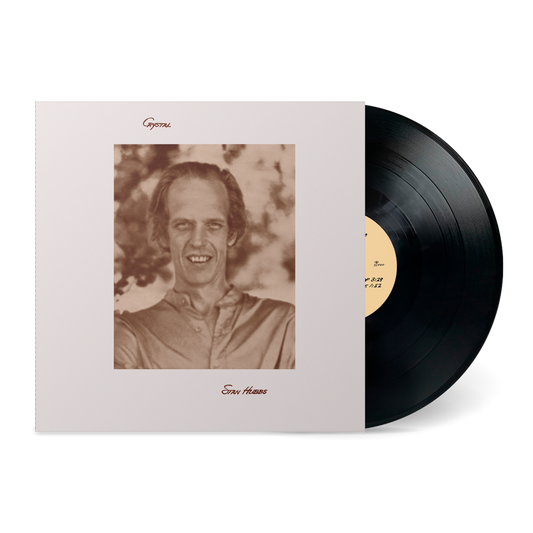
Gil Hubbs, Stan Hubbs' younger brother, wrote us a short memoir about his brother that opens up Stan's world to us and dispels a lot of misinformation about his art, life, and his album "Crystal."
With this new release of my older brother Stan’s album “Crystal,” I wanted listeners to learn a little more about the guy I knew.
Stanley Burr Hubbs was born in 1939 and I was born three years later. Stan and I grew up on the south side of Chicago in the community of Hyde Park near the campus of the University of Chicago. Our parents came to Chicago from Southern Illinois around 1925. Our Dad, Stan Sr (1903-1970), grew up on a farm with no electricity or running water. Our Mother Barbara (1903-1997) was living in Murphysboro where her father was a newspaper publisher.
In Chicago our father worked at a bank and then as a self-taught accountant. He started a restaurant and then built a motel and coffee shop on the southern outskirts of Chicago where Stan and I would work weekends and during the summer. My mother worked at the University of Chicago in administration. She was also a historian of Southern Illinois and in 1979 published a book about it called “Pioneer Folks and Places.” Mom’s family was very well educated, and she was determined that we would get a good education.
Because she worked at the university we could go to their lab school on very reduced tuition. We both attended from nursery school thru high school. At that time the university was unique. Students were not required to go to class and your entire grade was the comprehensive test at the end of the quarter. There was an atmosphere of Intellectual vitality, with remarkable faculty teaching and involved in innovative research. The Lab School was one school from 1st thru the 10th grade, when you received your high school diploma. There were about 50 kids in each grade, and many of them you knew for all 10 years. Many were the children of professors, some of them very accomplished and famous.
When you were in the upper grades you could take classes for university credit. I think when Stan graduated from high school in 1956 at the age of 16, he probably had about 1 or 2 years of college work already done. Stan was a real star in high school: basketball team, class president, popular girlfriends.
He went on the University of Chicago, graduating in 1958 at the age of 18. He studied literature and poetry, writing a lot of both. Hyde Park was very diverse in South Chicago, with a lot of change happening in the music. There were many bars with African American musicians bringing new sounds to the World. Stan and his friends would hang out. Music was really changing and he was very interested. Paul Butterfield was a year behind me in school and his brother and Stan were friends.

In 1958 Stan went off to Law School at Rutgers University for a year. I think he spent most of his time in the Village in New York City and was very influenced by beatnik culture and music of that time. In 1959 he came back to Chicago for a few months before moving to Venice California with his girlfriend. He worked at a bank in the trust department, writing poetry and starting to play more music.
After a few years Stan moved to Topanga Canyon, where there were a lot of musicians. This is when he started to concentrate on music. He got a band together playing a few clubs and festivals around LA. He told me the band Canned Heat lived next door. He started playing the Sitar. I believe he played with the Indian tabla player Alla Rakha, a collaborator with Ravi Shankar, on more than one occasion. I took the picture you see here of Stan playing at the Renaissance Fair in Topanga.
After a few years Stan moved to Northern California, living in several small towns near the Russian River and ending up homesteading in Camp Meeker. He organized a few bands playing in local bars sporadically. In 1982, at the age of 42 or so, Stan put in an order for 100 copies of his one and only vinyl record, “Crystal."
Stan continued writing music and poetry for the rest of his life. He self-published several volumes of his poetry. In 1994 he published an autobiographical novella called “Dreamers” every bit as atmospheric and singular as his music. I believe Anaïs Nin sent him a letter of encouragement. He also wrote an unpublished book, “Roots,” about observations on his life. Stan was an environmentalist and conservationist. Nearly all of his lyrics, notes and papers are handwritten on repurposed papers — fliers, ads, etc. The destructive nature of capitalism was a common theme of Stan’s writing.
Stan was a heavy cigarette smoker his entire life and passed away in 1996 from complications from lung cancer. Although he certainly enjoyed his share of pot, there’s no truth to the ridiculous idea that he died from a weed overdose. Stan was a brilliant and deeply principled artist. Although we were not in much contact in his final years, I loved and respected my brother and his commitment to doing things his way. This might also be the place to mention that according to the copious papers Stan left behind and which were mostly preserved, “Crystal” was one of nine or so completed albums. Unfortunately, it appears that the rest of his recorded discography was lost.
Stan would be thrilled to learn his music lives on and is being enjoyed by people. Thanks to all of you for your interest!
- Gil Hubbs, 2026

"Crystal" vinyl release available here, or stream here.