Few places changed as much as New York between the years of 1978, when the roaring tenure of mayor Ed Koch began, and 1990, the start of the considerably less-inspiring Rudy Giulianni era. New York was a national bellwether and a place of cautionary tales, a wellspring of new ideas brilliant and horrific, a city that seemed to rewrite its history and future with each passing moment. Hip hop fomented alongside the “greed is good” ethos and “broken window theory.” Crime, crack, and AIDS decimated the city’s most vulnerable populations, even as the city allocated $300 million to fight a “war on graffiti.” New York was at the center of it all, and at the center of New York was Edward Larry Gordon Jr., the artist also known as Laraaji Venus Nadabrahmananda, best known as Laraaji.
From 1979 to 1998, Laraaji lived in a tiny space in a brownstone apartment, located on the Upper West Side at 41 W 105th Street, near Central Park. “So small,” he said, “that sometimes I wonder how I did music in that room.”
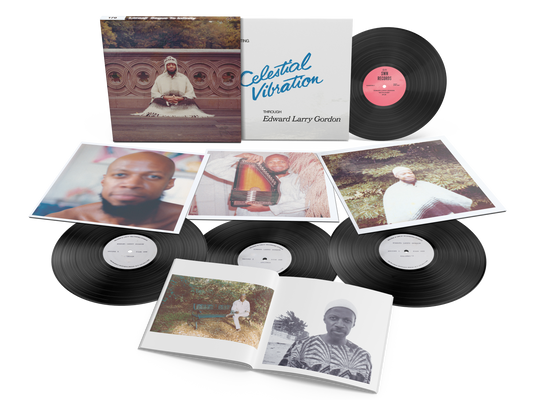
Along with that bedroom and the many spiritual conferences that got Laraaji out of the city on a regular basis, it was on the streets of New York where he channeled his music. In autumn of 1979, none other than Brian Eno happened upon Laraaji playing his zither, eyes closed, so deeply entranced in the music. Eno quietly left a handwritten note in his instrument case. Their meeting soon led to Ambient 3: Day Of Radiance, his first release as Laraaji. (A privately pressed album, Celestial Vibration, appeared a year earlier—his sole release as Edward Larry Gordon.)

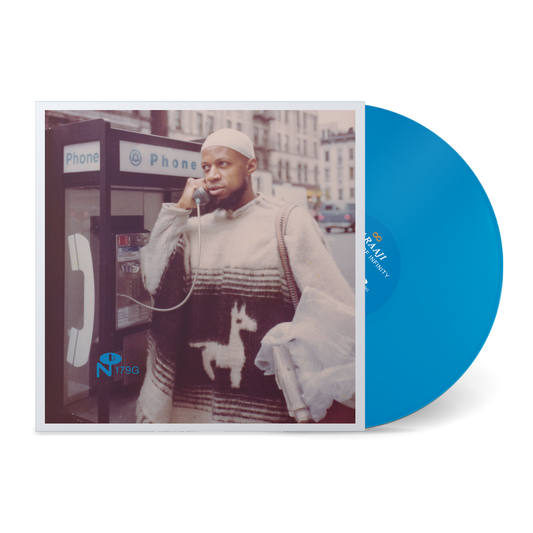
Almost thirty years later, Laraaji’s status as the elder statesman of new age music—its most beloved, visible, and credible spokesman—is indisputable. His career, so guileless as to merit quotation marks for most of its run, calls to mind the tortoise, slow and steady, winning the race. To anyone who knows him, the mere act of situating Laraaji in a space-time continuum seems odd. He is not just consistent, but constant.
He has, if not the penetrating look of a guru, then the grinning stare of the buddha. “No doubt that this is a moment of deep present time witnessing, of how the present moment is eternal, constant,” he said, describing the conception of “Today Is This Magic Quality,” a spontaneous composition created after an inspirational reading. “The sense of tomorrow and a yesterday doesn’t get a chance to really invade the present moment, because today never gives up its dominion; even at 12 A.M. today is still here.”
***
Laraaji was born in 1943, in Philadelphia. Young Larry Gordon lived for a time in Germantown, Pennsylvania, but spent the greater part of his childhood in Perth Amboy, New Jersey. Almost every Sunday was spent at the 2nd Baptist Church, where he sang in the choir and served as an usher. “It was a 2nd Baptist,” he said, “because later I found out that 1st Baptist church is traditionally attended by people of white origin. 2nd Baptist is usually people from the south or southern origin.”
Larry was a scholarship student, and considered going into engineering or architecture, but opted for the Howard University College of Fine Arts, majoring in theory and composition with a focus on the piano. He attended university for four years but stopped just short of earning enough credits to graduate. “[I accrued] enough information and technique so that I wouldn’t feel like a trespasser in the field of music,” he said.
During this time Larry became invested in comedy, and performed in talent shows. “I was recognized as a funny person in school, in church, on the playground,” he said in his inimitably deadpan way. By 1966, during his last year at Howard, making people laugh seemed to be the thing. He arranged to make his New York City debut at an open mic night at the legendary Bitter End in New York City. Larry’s performance went over so well that he decided to move to the city and make comedy his vocation. He appeared at the Apollo and did the northern hootenanny circuit—talent road tours arranged by the US department of labor’s job corps program, mandated to promote diversity and good times. (Hootenanny is a Scottish term for celebration, and became an Appalachian colloquialism for a “thing,” like doodad or whatchamacallit, but more specifically to describe parties involving folk music.) By the late ’60s Laraaji was represented by Ernestine McClendon, who ran the most prominent Black theatrical agency at that time. This led to a brief but memorable appearance as Mr. Victrola Cola in Robert Downey Sr.’s countercultural classic advertising satire Putney Swope in 1969.
Looking back on his early years, Laraaji said: “Jesus was the primary center of attention. I can’t say that I ever really understood everything about the bible and the teachings of the preacher at that time, but it started to click when I started experimenting with the sacred, intentional offering of marijuana to my higher consciousness teachings… I knew very little if anything about ganja, marijuana, or psychedelics. It wasn’t until my second year of college when I felt guided by this cosmic intervention to investigate and explore the use of psychedelics for opening consciousness to a realm that’s not usually accessible to the linear mind.”
As to the question of whether the then-illegal sacrament of marijuana was part of his musical creative process, Laraaji is categorical. “Would I honor the herb? I would honor the herb quite often. The chances were that if I were doing a late night recording, yes. If I was doing a performance in front of a live audience, no.”
***
Laraaji existed between two worlds, one Black and one white. Though he has spent more or less his entire adult life in the Upper West Side and Harlem, the new age conferences up and down the eastern seaboard he frequently travelled to were almost entirely white.
***
Laraaji admits to never putting much effort into pushing his music toward Black audiences. (“How come I never heard of Laraaji?” he asks rhetorically, laughing. “He’s Black, he’s a brother, why I haven’t I heard of this guy?”) In fact, to the best of his recollection, Laraaji only played publically in Harlem once, in the 1970s at The Tree Of Life bookstore at 125th and Lenox, and its Aquarian Science Free Reading Room, which offered more than 7,000 titles to the community. “Every Black resident in New York who was into new age spirituality in those years remembers it.”
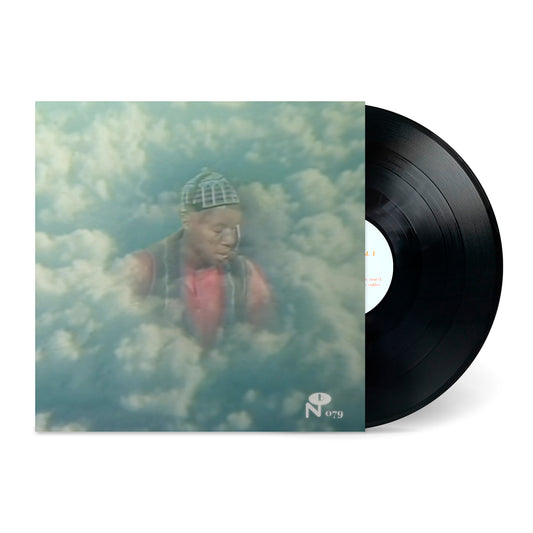
Vision Songs Vol. 1, Laraaji’s magnum opus and outlier—composed of gospel-inspired lyrical songs rather than the long, free form instrumentals for which he is best known—began not in isolation, but through the force of others. He used the MT-70, a consumer-grade synthesizer built by Casio to mimic the Hammond organ sound, and equipped with “a peppy drum machine,” as Laraaji puts it. He owns and uses the keyboard to this day, but along with his 1981 long-form psychedelic masterpiece Unicorns In Paradise, Vision Songs represents his most Casio-centric recording.
“It started out as my being up late with a synthesizer at whosever’s home I was in and just jamming, with someone at an ecstatic spiritual community that invited me to do a house concert with beautiful people into meditation or yoga, and so I guess I felt the shakti and spiritually inspired [to create] songs of service and supporting people on their journey. I felt a warm connection both with people who were present, and also the spiritual community that I haven’t met, that would eventually get to hear this music, the spiritual community in the sky.”
Concert improvisation “spontaneously drawn out of the sky” would later evolve into home recordings after attendees requested them. “I was in a period in those ’80s of spiritual exploration and unfoldment, and the bliss of realization and the freedom that comes from knowing the self as beyond the world’s perception of the self just wells over into music when I’m feeling good at the keyboard or the zither.” Two of his most explicitly inspirational pieces “All Of A Sudden”, and “The Laws of Manifestation,” emerged from jams at these meetings.

Laraaji and his zither
At the Southeastern Spiritual Conference at the Guilford College campus in Greensboro, North Carolina, Laraaji would meet an ex-colonel named Joe Tucker, who would become one of many spiritual mentors, shortly before Joe “passed on to his higher goal.” During their time together Joe spoke of “places that were vast, near, sweet and dear, and was definitely an initiate of some higher calling.” Laraaji memorialized his teacher in the ebullient “Cosmic Joe,” a composition Laraaji has revisited in different forms throughout the years.
“Bliss Out For Days” was the product of a two or three hour jam-inspirational spontaneous recording edited into one of Laraaji’s most conventional, splendidly simple compositions. “It came out of the sky… in the moment totally blissed out, ecstasy, ecstatic, immersed in the wonder of the now… The lyrics were not prepared, I didn’t even have a premise of where to go, it just came out of the moment.
***
One may assume that the notion of escape—from economic conditions, from the indignities of childhood, from the horrors of history, from the worldly plane itself—looms large in Laraaji’s creative universe, as it clearly does in the work of so many of his new age contemporaries. But Laraaji’s greatest creativity is rooted in a sense of profound engagement with the world. Of the mental imagery of Vision Songs, he said, “some visuals that come are emotional, compassionate imagery of humankind, or the planet, celebrating higher consciousness of the unity. Sometimes I get images of the planet being immersed in well-beingness or immersed in a light every individual can translate down into their own personal space for their own good.”
“When I’m doing zither work I’ll use images like water or elemental images to inspire flow of music… I’ll use images of angels dancing, or etheric being moving in space, or mythical human culture doing celebratory folk dances somewhere.”
“I call it a bulk download—a visionary zap of vertical energy, and I spontaneously spill it out into the linear plane as a song, as words that weren’t thought of before. The feeling when I’m in the midst of that happening… I do feel images and I do feel intimate oneness with the creative intelligence of the universe. During “We Shall Be Lifted” I felt a sense of humankind being visited by a higher vibrational force, and stimulating consciousness so that it drops its old patterns and is prepared to move into a new configuration of humanity… Light seems to be the ongoing theme, light and lightness are one and the same to me. To be moved from heaviness, density, darkness, confusion and doubt into lightness, peace, gentleness, and spaciousness. A little bit of that sounds reminiscent of my experiences with the Holy Bible, the prophesy of former things passing away, the old patterns in our evolution that were necessary for us to discover ourselves, individually and collectively are dissolved by some force, some mystical compassionate force [to] collectively bind us where unity and oneness is effortless.”
***
Laraaji cites Religious Mind Science, Sri Chimnoy, Swami Satchidananda, Shri Brahmananda Sarasvathi, Ram Dass, and Bhagwan Shree Rajneesh as influencers during this time. As with Cosmic Joe, a deep spirit of mutual respect seems to bind Laraaji to his lesser-known teachers, some of whom helped encourage him to record and release his work.
Loving Relationships Training founder Sondra Ray is one of many teachers who gravitated to Laraaji and his music. Ray was a devotee of a guru Haidakahn Baba, said to have first appeared in a cave as a twelve-year-old boy, reincarnated from one or more Hariakahn Babas. Ray’s teaching was focused largely on the chant Om namah shivaya. Shortly after Haidakahn Baba transitioned out of the body and back into the ether in 1984, Laraaji channeled a 40-minute long jam from this happening and dubbed three copies. He gave one to Ray, who liked the tape and asked him to “mass produce” it, leading in 1984 to, like all his ’80s work, a batch of maybe 100 cassettes sold or given away at conferences and on the streets of New York.

The inspiration for “Great Bells In The Morning” came from a stoned meditation in 1974. “Standing in front of a mirror and making eye contact with myself, and going into this altered state and hearing cosmic music, many layers of brass-sounding instruments filling up all of cosmic space… It was a very un-normal way of hearing music, because it wasn’t like processing from linear sound originating from some distance to my ears—it was more like a pulsational vibrational music that was everywhere at the same time and seemed to highlight the nature of eternity, the nature of eternal now and the nature of eternal field. I was blissed out, blown away and awed. My analytical brain was trying to figure out how to record this or how I could write it down, or how was this was happening, how do you have this kind of hearing experience without the ears being involved. It might have lasted five-ten minutes and it happened at the outset of my normal meditation period which was twelve to five in the morning at that time. And so that experience set the tone of “Great Bells In The Morning,” great sound, sound that lifts us up and changes the way we perceive the universe, time, space, and energy.”
***
One of the more miraculous inventions of late ’60s American media, cable access television, also known as public access, came to be when the FCC saw virtue in the cultivation of non-commercial programming created by the people, for the people. It grew as cable television grew, and reached the zenith of its popularity in the 1980s, The medium exists today as a shadow of itself, with YouTube’s ascension providing the primary rationale behind its defunding and discontinuation. While this may be a reasonable argument, it’s undeniable that the special handmade flavor of creativity in public access has no exact analog in the digital age. This may be in part because of the winnowing effects of public access’s low-but-present barriers to participation: show fees and classes leading to a simple accreditation process. Self-expression online may be weirder than ever, but nothing can replace the shock of flipping from a commercial channel to a public access one and discovering real people doing real things—not for money but out of a deep need to express something not expressed anywhere else.
***
In early ’80s Manhattan, there were no less than three 24-hour public access stations, with another in Brooklyn. Laraaji became inspired during this time to create his own program on upper Manhattan’s Group W Cable. He called it Celestrana, “Designed,” he said, “to capture the attention of people flipping channels – to stop and say, what is this?” Between 1982 and 1989 Laraaji recorded about 25 episodes, of which twelve are known to have survived—because he had the foresight to rescue them from station tape libraries as the station was slowly subsumed into the Comcast media empire. These remarkable song-chant-dance-puppet show jams are best seen for themselves in all their bizarre glory. (Don’t miss Dr. Peace and Dr. Love, twin frog puppets chanting in a spontaneous, “transcendental psychoactive language”.) Like an east coast twin to Alice Coltrane’s late ’80s Eternity’s Pillar cable access show on KTTV in Los Angeles, Celestrana is a riot of spiritually-inspired creativity and DIY resourcefulness and resembles some kind of transmission from another, better world.
***
The renaissance in new age music in the new millennium has been good for Laraaji, and he continues to play more and more to admirers in their twenties and thirties, in greater numbers than ever before. He now splits his time about evenly between his traditional circuit of boomer-populated Vedanta temples—like the Ananda Ashram in Monroe, New York, where Laraaji has been going for a “spiritaul rev up” about four times a year since 1979—and electrified hipster festivals including Moogfest in North Carolina, Bonnaroo in Tennessee, and Le Guess Who in Utrecht.
***
There has never been, and never will be, another musical career like Laraaji’s. Forty-plus years of dedication and focus, culminating in something resembling mainstream recognition and success, feels like something impossible to replicate in the post-internet world. The obliteration of the notion of “selling out” seems to preclude another spiritual seeker from ever walking a path as commercially indifferent as Laraaji’s. The Hare Krishna centers where Laraaji went for “the best free meals” in the Vision Songs days are mostly gone now. The crime-ridden mean streets of New York have been steam cleaned, painted over, and razed to make way for luxury condominiums. Even Harlem, where Laraaji has resided since the turn of the century, seems to be well along the way to being a place where artists can only dream to live, and this transformation is not new—a CVS pharmacy sits where The Tree Of Life was closed down in 1980. There will always be pure-of-heart troubadours existing outside of the popular music rat races, but the possibility of another urban saint like Laraaji, a product of the merging streams of gospel, comedy, R&B, the privileged world of new age spirituality, and the desperation of bare bulb New York in the ’70s and ’80s, is probably off the table for good.
Along the way, Laraaji had a daughter, Nilaja Sun, who came into the world in 1974. Nilaja studied acting and theater, and began teaching in 1998 at a performing arts high school. She made a name for herself with No Child, an award winning, 14 character/one woman show based on her experiences as an educator. No Child premiered in 2006 at the Beckett Theater on Theater Row off-Broadway.
In an interview, Nilaja said that “Solo theater is important because the audience is reminded that with just one person they can be completely transformed, their souls can be transformed, their hearts can be transformed, hopefully their minds will be transformed, and in a small way their lives can be transformed. In just one moment, maybe one hour, witnessing one person, and in a way that feels like God’s work,” she said.

Nilaja defines a great solo performer as “one who brings the audience to a breathless place, then reminds them to breathe… so we’re all breathing at the same time… that one breath means we are all one.” She enjoys steady employment as a character actress, appearing, for example, as a disappointed and alarmed school administrator in the pilot episode of Louis CK’s Louie.
“Her mother’s and my lifestyle shifted and we lived in close proximity in Park Slope,” Laraaji said. But when he “began to live a more nomadic lifestyle,” they “didn’t have much physical contact in her formative years... I see her on the most serendipitous situations, and we click, we dance, we laugh, we hug, and then she shares some strong emotions over the feeling of not having had me around in her earlier years.”
A similar positive-negative charge binds Laraaji to the rest of the Gordon clan. “Although they wish me well, they don’t fully grasp the inspirational level at which I’m being driven. They’re still friends with the Baptist church, but I think that my consciousness shift in the ’70s kinda took me out of the box and almost made me slightly incomprehensible, so I don’t really talk my philosophy or insights around them when I visit. We more or less hug and eat food and laugh and there’s a warm interaction.” The statement is neither wistful, nor regretful, nor seemingly loaded with a desire for more than to describe what is.
“Now and then I’ll sit down and think to myself, what if I struck and started from scratch from this moment, how would things reconstruct themselves for me? And when I do that, I’m pleased to observe that not much would change,” he said. “It’s constantly being affirmed that the guidance I have is the best guidance I can have.”
- Douglas Mcgowan, Los Angeles, 2017